
This type of cable is the workhorse around the world in systems at all levels. However, getting a signal completely intact from one box to another in a system is a serious matter as many factors conspire to make the journey hazardous for what is a fragile and easily damaged signal.
In order to make significant improvements we had to address just about every component and its fundamental design.
It has been taught for decades by educational establishments that signals flow in cables. The perception of how a cable works, supported by top academic physicists in the United States, has driven us to develop a completely new modality for HiFi cables.
This controversial video by Veritasium, ‘The Big Misconception About Electricity explains the vital importance of the field concept. In addition a British take on the same subject (Electricity does not flow through wires! – Energy One). We hope these links will help you to understand why we have taken this approach.
Our three current cables are designed to maximise this new thinking and to access, hitherto unrevealed parts of your recordings.
Terra Nova Interconnect & Ultra-Litz Field Cable – Editors Choice Nov ’24
The benefits of our balanced cables are very similar to our single-ended cables with one important difference. Most balanced line cables comprise two cables + and – surrounded by an earthed screen which is constructed from a cylindrical fine mesh of copper. This fine mesh ‘Protects’ the signal from the ingress of distortion carried by induction via frequencies carried in radio waves similar in nature to how a domestic Wi-Fi network works.


This has been the Modus Operandi of these cables for over sixty years. We have discovered and we are not alone in holding this view, that the copper screen, rather than protecting the signal, actually inhibits the formation of a field around the cable. Furthermore, we have demonstrated that if the screen is replaced with a Litz earthing cable then the sound stage is projected further with more detail hinting that some of the signal is not carried in the cable but in the three-dimensional field around it.
The diagrams below show a simple circuit driving a lamp the alternate fields changing from the first graphic to the second 60 times per second and the resulting fields showing rotation and polarity.
For decades the Recording and music industry routinely have used screened cables for microphones and in other key areas to make recordings. This explanation of the application of Amperes Law applied to a screened cable conclusively supports our argument that some of the signal gets lost
All look relatively calm and logical however inject the music of the Rolling Stones into the diagram replace the lamp with a power amplifier or pair of speakers and imagine the scene. This puts cable supports and risers into a different light and we are currently conducting R&D into this very subject.
The XLR plugs we fit to our balanced cable are made by Atlas in Scotland as these are one of the only companies that offer a crimpable solution.
Loudspeaker cables do not connect directly to speaker drive units, but in most cases, they connect to a passive speaker crossover network. This network divides the signal into many parts by frequency and feeds the result to the disparate drive units at the front of the speaker. All fine in theory; however, this filtering comes at a price, which is paid in the form of dipping impedances (AC Resistance), which can go lower than 2 Ohms and can make, particularly tube amplifiers, very hot under the collar. This phenomenon puts a large current demand on the power amplifier, which, out of necessity, requires a thick cable to deliver it safely. To dispel any nervousness, this only happens at certain frequencies; for the rest of the time, calmness returns.
When developing our speaker cable, we, of course, had to consider the above scenario and build into our solution sufficient cross-sectional area of cable to more than cope with this. We also learned lessons from our smaller cables and gained great advantages by following in their footsteps in terms of avoiding plastic as an insulator and making the dominating mass two layers of felt to deal with the insulation and, as importantly, control of vibration.
Comprising 8000 strands at 30 microns in diameter per conductor, our cables transport the signal they carry very gently and simply do not get in the way of the hard-won detail and ambience of the original recording. As in our other cables, we do not use solder and have designed our handmade spade connectors crafted from solid silver and hallmarked in the UK by the Birmingham Assay Office (Founded in 1773). These are crimped to the naked copper strands using a hydraulic crimper with up to a ten-ton pressure. This ensures the removal of any air from the joint. This makes a perfect metal-to-metal junction inside the joint, which will not oxidize over time and carries the signal cleanly from your amplifier to your loudspeakers.
We are frequently asked about our silver tarnishing. The rate of tarnish will depend on atmospheric cleanliness. We supply a safe and eco-friendly silver cloth, which we recommend that you use on the terminals once a year. Providing terminals are tightened well at both ends of the cable, tarnishing should not be a problem.
Nikola Tesla invented Litz cable to carry AC current. We stand on this legend’s shoulders.
When you switch on a toaster, a blender or a coffee machine, the fact that in the UK what is carried in the cables is to say the least bipolar, changing its mind fifty times a second, switching from positive and back to negative, makes not a jot of difference to your breakfast.
It is a completely different matter when powering Hi-Fi. For over twenty years, it has been recognised that the quality of the ‘fuel‘ understandably affects the performance of the ‘car’.
The sound produced will not be at its best if what comes out of the socket in your wall is not of the best quality.
There are numerous products used by Hi Fi enthusiasts that clean the power and in some cases regenerate it as indeed there are mains leads. However, the electricity is still oscillating at fifty or in the US sixty times per second.
This oscillation invariably carries energy, which causes movement, which can translate into noise which, although inaudible, creates a higher than optimal noise floor, which when entering your Hi-Fi can lead to sub-optimal performance.
Ultra-Litz Field cables is composed of four thousand and eight thousand individual copper strands. Each strand is only 30 microns in diameter and individually insulated. Each strand is wound in a linear spiral, travelling in from the edge to the centre and out to the opposite edge.
This helical structure keeps the variables of capacitance, Inductance and impedance far more stable than a conventional cable. In addition, there is no PTFE, FEP or any of the usual insulators. We use silk cotton and wool, all have far better insulating properties than petrochemically derived insulators. In addition, wool felt that has been used to eliminate vibration for decades replaces over 50 years of sheathing Hi-Fi cable in plastic.
If you know our interconnects, you will know that we take the control of vibration seriously, making close fitting felt socks for our RCA and XLR connectors. These make fine detail, including air and space, more audible. During this period our technology was chosen over other cable manufacturers to make a bespoke 4 x 4K strand umbilical power lead for one of the worlds greatest amplifiers (Ref.Robert Harley Editor of Stereophile Magazine 2025). The Berning SET Valve Amplifier.
With this in mind, we have developed a proprietary damping product Kerakinetik© (K3), which markedly reduces harmful AC induced vibrations within the Mains and IEC plugs whose terminals are fabricated from solid copper which is silver plated. The plug terminals are fitted with spring washers to ensure constant pressure between terminal and cable. There is no point in greatly attenuating vibrations in the cable, for it to be regenerated by passing through an undamped plug.
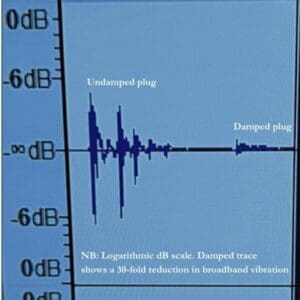
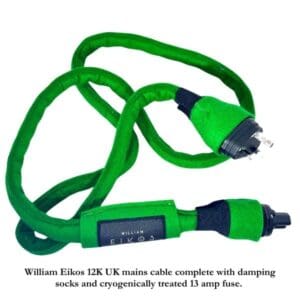
Two grades incorporating Ultra-Litz 4,000 and 8,000 stand cables with plugs utilising Kerakinetik© (K3) proprietary internal damping technology. International plugs available on request.
Like all Ultra-Litz products, our mains cable will allow you to hear your music in a more realistic and dynamic way, further enhancing the total clarity that is the hallmark of the rest of the range.
William Eikos is pleased and privileged to have been chosen out of eighteen other cable manufacturers to make, as an OEM, a variant of our Ultra-Litz Loudspeaker Field Cable as an umbilical power lead for the prestigious Berning SET (Single-Ended Triode) OTL 20 w Reference Amplifier. This 4-chassis amplifier represents the final iteration of the Berning ZOTL circuit, utilising the incomparable Ypsilon-manufactured silver wire wound external 45-pound inductors.
This decision was made by David Berning, Steve McCormack, and Rick Brown.
This amazing product, priced at $250K, has been reviewed by Robert Harley, Editor of The Absolute Sound Magazine and has awarded a Golden Ear Award.
At William Eikos, we’re transforming the way you experience sound. The Ear dives into our revolutionary Terra Nova interconnect and Ultra Litz Field speaker cables, showcasing how our ground-breaking designs eliminate interference and vibration to reveal the purest, most immersive audio imaginable”.
William Eikos Terra Nova Interconnect & Ultra-Litz Field Speaker Cable – Editors Choice November ’24: The Ear.net
Not satisfied with bringing you the largest upgrade in the history of our cable with Selective Field Management Technology
We proudly present Ultra-Litz Field Cable
In a world first innovation, we bring you all the technical attributes of our best cable, now with the advantages of Italian cashmere felt.
*Technical details: Cashmere has a dielectric constant (permittivity) lower than wool felt, already one whole number lower than PTFE. Cashmere’s fibres are finer than wool felt, making its kinetic transfer factor more efficient. No damping socks needed.
Almost nothing is comparable in a one to one sense. The new tech delivers on bass first. It is seriously more robust and fuller. Then the noise floor (and lower grain as a result), image density, sound staging especially front to back depth, holographic focus and a tonal balance that is burnished, beautiful and extended.
Rick Brown - Hi Fi One, Carlsbad, California Tweet
I have been listening to interconnects for years and thought I had the best but this has beaten everything I have.
David Denyer PR - UK Hi-Fi Opinion Leader Tweet


